XENHO Designs Rugged AC Contactors for High-Frequency Motor and Remote Control
As a professional AC Contactor manufacturer and supplier in China, XENHO factory delivers high-quality, durable, and cost-effective AC contactors for industrial applications, supporting OEM/ODM customization and bulk procurement needs.
What is an AC Contactor ?
AC Contactor (Electromagnetic Contactor) is an automatic switching device used for frequent on/off control of motors, power lines, capacitors and electrical equipment. It is widely applied in power distribution, motor control, fan, water pump, air conditioning, hoisting and automation systems.
Key Features
High Switching Frequency: Suitable for frequent start/stop operations
Remote Control Capability: Easily integrated with PLC and automation systems
Arc Suppression Design: Ensures safe switching and extends lifespan
Modular Structure: Easy maintenance and flexible expansion
Wide Voltage Options: Compatible with global standards (24V–380V AC)
Durability & Stability: Designed for harsh industrial environments
XENHO Contactors are classified by pole number, rated current, control voltage, coil type, application and structure, to meet different control requirements.
| Category | Type | Specifications / Range | Key Features & Applications |
|---|---|---|---|
| 1. Pole Number | 3-Pole | Standard | Three-phase main circuit control; used for motors, fans, pumps, and compressors. Most common in industrial applications. |
| 4-Pole | Standard | Used for three-phase four-wire systems (with neutral line); applied in power distribution, lighting, and special control systems. | |
| 2-Pole | Standard | Single-phase power control; used for household appliances, small power equipment, heaters, and lighting. | |
| 2. Rated Current | Mini Contactor | 6A ~ 32A | Small loads, control circuits, lighting, and small motors. |
| Standard Contactor | 9A ~ 100A | General-purpose for most industrial motors and equipment. | |
| Heavy-duty Contactor | 115A ~ 800A+ | High-power motors, large equipment, heavy industrial applications. | |
| 3. Coil Characteristics | AC Coil | 24V, 36V, 110V, 220V, 380V AC | General industrial control. |
| DC Coil | 24V, 48V, 110V, 220V DC | Used in automation, PLC control, and DC systems; offers stability and anti-interference. | |
| Wide Voltage Range Coil | Varies | Suitable for unstable power grids; features high anti-interference, low noise, and long service life. | |
| 4. Function & Application | Ordinary AC Contactor | Standard | Basic motor control and circuit switching; used for general machinery, fans, and pumps. |
| Capacitor Contactor | Specialized | Specifically for switching power capacitors; used in reactive power compensation cabinets. | |
| Reversing Contactor | Mechanically interlocked | Two contactors interlocked for motor forward and reverse control. | |
| Timing Contactor | Built-in delay | Used for delayed starting or delayed stopping control. | |
| 5. Auxiliary Contacts | Basic | 1NO + 1NC | Provides basic control and signal feedback. |
| Multi-pole | 2NO + 2NC or more | Suitable for complex control circuits, interlocks, and signal systems. | |
| Plug-in | Modular expansion | Flexible expansion; convenient for maintenance and replacement. | |
| 6. Protection & Feature | Conventional | Open structure | Standard design for installation in control cabinets. |
| Sealed / Dustproof | High protection rating | Strong environmental resistance; used in harsh working conditions (dust, moisture). | |
| Silent Contactor | Low noise design | Suitable for noise-sensitive environments like buildings, commercial centers, and offices. |
FAQ
Q1: What is the difference between AC and DC contactors?
A: AC contactors use AC coils and are designed for alternating current systems, while DC contactors are optimized for DC circuits with better arc suppression and stability.
Q2: How to choose the right AC contactor?
A: Consider: Rated current & voltage; load type (motor, capacitor, resistive); coil voltage; number of poles and working environment.
Q3: Can AC contactors be used for motor protection?
A: They control motors but must be used with thermal overload relays for protection.
- View as
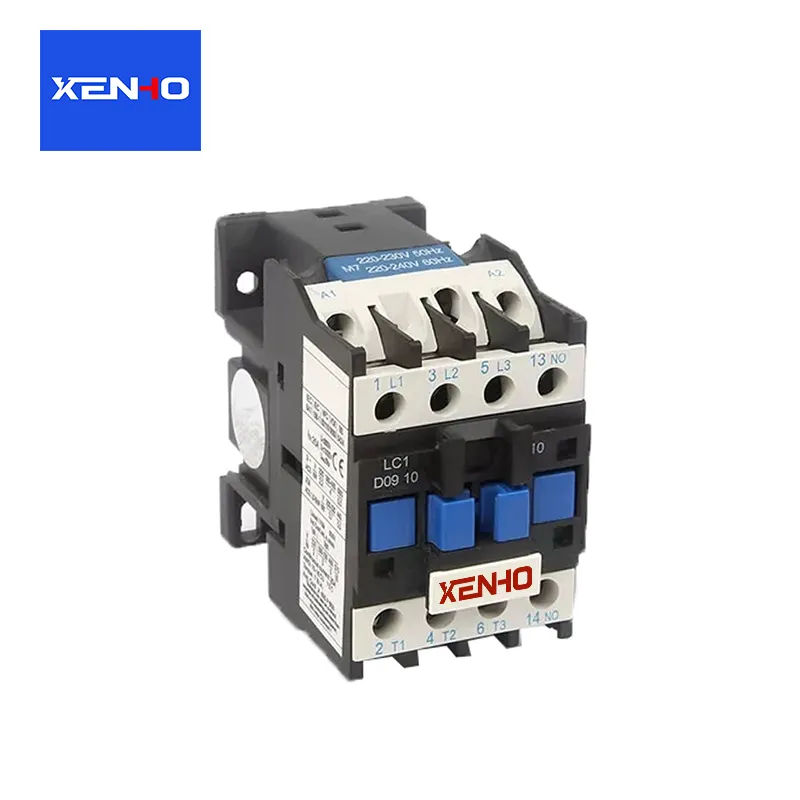
4 Pole Contactor
As the professional manufacturer in China, XENHO would like to provide you high quality 4 Pole Contactor, which is a high-performance electromagnetic switching device designed for AC 380V circuits, with a rated current range of 5A–63A. It is engineered for frequent switching of motor loads and provides stable, low-noise operation in demanding industrial environments.
XENHO as a professional manufacturer and supplier of quality AC Contactor in China. With our own factory, we provide customized services and look forward to partnering with you.